
Showing posts with label Malawi. Show all posts

Wednesday, July 07, 2010

Malawi agriculture hits new landmark with Purchase for Progress


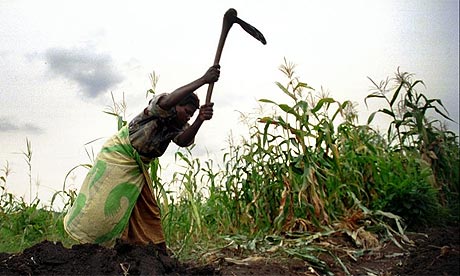
On July 2nd, Malawi announced its first transaction with the World Food Program's Purchase for Progress (P4P) initiative. In the first week of the program, the WFP purchased 50 tons of maize through the Agricultural Commodity Exchange for Arica (ACE), a commodity exchange market operating in Malawi, from the Grain and Legumes Association, which is a farmers organization with over 95,000 participating small scale farmers. The P4P initiative provides technical support to small-scale farmers and buys surplus food supplies in order to maintain fair prices, thereby allowing farmers to maintain higher agricultural production and higher quality crops.

The P4P initiative in Malawi is expected to improve the livelihood of over half a million small farmers, most of whom are women, by 2013. The P4P initiative is operating in over 21 countries and it recently expanded it's purchases in Ethiopia. With their newly found profits, Malawian farmers have been able to invest in improved crop storage, seeds and fertilizers for the next growing season.

The P4P initiative is huge step for Malawi, especially when compared to where the country was 5 years ago. In 2005, Malawi was in the middle of a massive famine, with over 13 million of its inhabitants living on emergency food aid. In just two years, however, Malawi had transformed into one of sub-Saharan Africa's largest food exporters. This dramatic change has been dubbed the 'Malawi Miracle.' Through intensive government subsidies for seeds and fertilizer, Malawi was able to nearly triple its production of corn in two years. The 'Malawi Miracle' plan has been so successful that more than a dozen other African countries plan on initiating their own subsidy programs.

-Matthew Thwaites


SOURCES:Statement by WFP Executive Director on Purchase for Progress Initiative in Malawi

Sunday, August 09, 2009

Crowdsource Information Provides Insights in Africa


Ushahidi is a new program designed by a group of international developers to crowdsource information in crisis situations. People can send in texts, emails or fill out a webform to inform others on up to the minute information. The information Ushahidi receives is plotted on a map with time specific details.

The idea was developed when there was post election violence in Kenya. Ushahidi, which means “testimony” in Swahili, was an answer to providing the outside world with reports of what was happening throughout the country. A team of four created this resource since they knew that mobile phones were widespread throughout Africa and people could communicate importance facts easily in this way.

Currently, Ushahidi is being used for programs such as Stop Stock-Outs. Researchers visit health institutions in Kenya, Malawi, Uganda and Zambia to see which medicines are readily available and text the missing medications to Ushahidi, who plots them on a map. Other projects include TXTPower in the Philippines, Cuidemos el Voto mashup in Mexico and Peace Heroes in Kenya.
--Jessica Milstead

Source: Ushahidi.com

Tuesday, June 30, 2009

Inventor Creates Power Source for Africa


Dr. Cedrick Ngalande is a Malawian inventor for the world’s poor. His main efforts have gone toward developing new methods for rural Africans to generate enough electricity to power small electrical devices like cell phones. Ngalande’s invented an inexpensive power source that is run on sugar and yeast. Because sugar and yeast make alcohol, the generator is able to harness energy by releasing the product of the solution’s expansion through a valve. The prototype, made specifically for Africa, generates power for up to 8 hours at a time.

With the fastest growing cell phone rate occurring in Africa, there are big challenges to using the hand-held technology because electricity is scarce in the region. While many Africans may have mobile phones, they have a difficult time charging them. Some walk long distances to simply charge their phones. But with the help of Ngalande’s generator, charging electrical devices is less of a challenge. In addition to cell phones, Ngalande’s power source can also be used to charge $100 computers which are being introduced in Africa, and even charge or operate medical devices in rural Africa.

Dr. Ngalande is seeking investors to help him manufacture, market and sell his low-cost generator in Africa.

-- Jaimie Hwang

Source: AfriGadget