Showing posts with label Uganda. Show all posts

Friday, October 14, 2011

A Ugandan Midwife's Mission to Save Lives


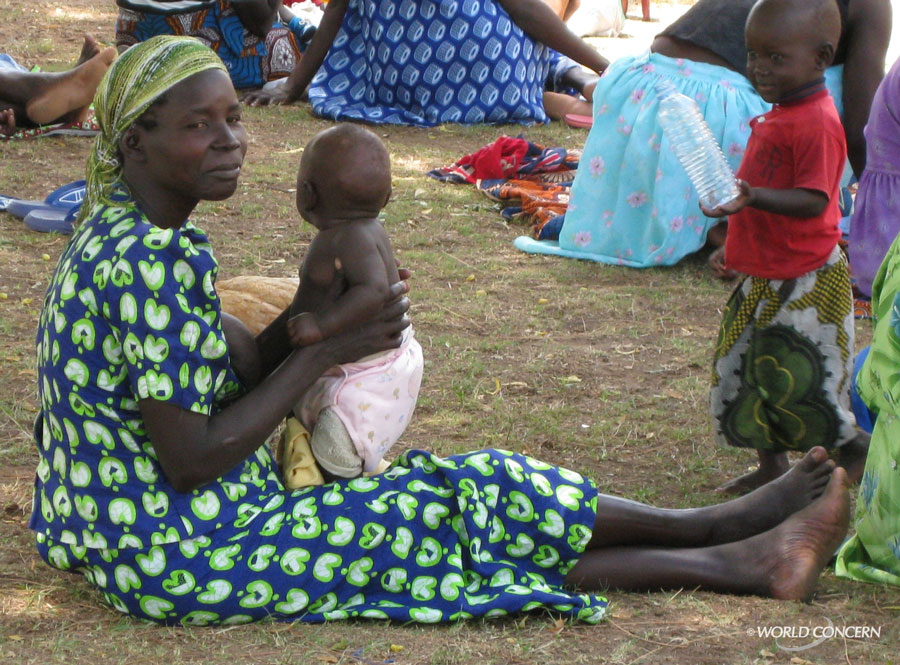
Another miracle is brought into this world in the Katine village of North East Uganda.  New mother, Priscilla Alupo, smiles from ear to ear as she eagerly shows off her new son, George, to visitors.

Esther Madudu, one of three midwives at Tiriri health center, helped to deliver George along with the births of four other babies all in a single night's shift.  Midwife for 11 years, Madudu, 31, is passionate about what she does.  "I love talking about the mothers I help deliver.  We deliver 45 to 50 mothers every month, so I save 45 to 50 mothers and babies a month."  During her time at Tiriri, no mother has died during childbirth.

The problem here lies in the condition of the center.  Giving birth at night is a bit difficult with no electricity. So how do these women overcome this hurdle?  Well, they use the light cast by mobile phones, which are held in their mouths to ensure the beams are directed where needed.  The damage that has taken place eight years ago to the Katine village has left the health center no power supply, but fortunately their water source is still in tact.

Scheduled to attend the Women's Forum Global meeting, in Deauville, France, Madudu will address delegates about her work and the health challenges faced by women in Africa.  With the launch of her campaign, Up for African Mothers, coming up, the severity of this continent's high maternal mortality rates will hopefully raise the much needed political attention.  Looking on a larger scale, it goes without saying that the millennium goals to reduce death rates among women and children in these poor countries will not be met by 2015 if the sufficient funds aren't received.

Here are some statistics to think about:
  • An estimate of 358,000 women die in pregnancy or childbirth every year due to lack off access to basic medical care or trained staff
  • Majority of deaths occur in sub-Saharan Africa
  • 70% of women don't receive prenatal care and half of all deliveries take place at home without medical assistance
In a rural village like Katine, the wages are low and the housing is inadequate.  Yet, these factors are looked past.  "When you love your work and want to save lives of mothers, you go there.  That's why I stay in Tiriri.  The pay is little, but God pays me because I know I have saved lives," explains Madudu.  Within the next few years, she will travel the world to promote the African mother's campaign.

"My dream was to save lives. When you hear a baby cry on delivery, everyone begins to rejoice."
- Esther Madudu, Midwife and Advocate

-Georisa Chang

Source: The Guardian

Tuesday, December 14, 2010

Giving the Poor a Voice & a Conference


In response to the UN MDG Summit in New York, the idea for a conference featuring the world's actual poor (and not just word leaders and celebrities) was born from a Twitter discussion about the lack of grassroots voices at the Summit.

This idea became the "Villages in Action" conference, which was held on November 27 in western Uganda. Almost 600 villagers gathered to have a conversation about the state of development in their region, and whether or not that development was in line with achieving any of the Millennium Development Goals. The conference was broadcast globally and with the help of the internet the rest of the world could engage directly with the grassroots people.

As the co-founder of Project Diaspora describes it, this conference was less about the numbers, charts and power-point slides, but more about the local community working together and celebrating everyday life. "It was about making sure everyone knew that their efforts contributed to a whole. This was about showing the power of ubuntu – "I am because you are"."

-Clare O.

SOURCE: The Guardian

Tuesday, November 30, 2010

White House Unveils Lord's Resistance Army Strategy


This week the White House released a 33 page policy memo detailing its strategy in defeating the Lord's Resistance Army and mitigating the damage caused by them. This is the first time that an administration has released a full report and strategy for Uganda.

The Lord's Resistance Army, a terrorist group that blends elements of mysticism, Christianity, and doomsday prophesy to stir its followers, has led a rebellion against the Ugandan government for over thirteen years and use sex slaves, rape, and child soldiers to further their goals.

This document, prepared as a result of the Lord’s Resistance Army Disarmament and Northern Uganda Recovery Act of 2009, outlines specific goals and objectives that the Obama administration wishes to achieve, including the elimination of the army, the prosecution of Joseph Kony and other leaders, and meeting the basic needs of the Ugandan citizens.

-Corey Cox

SOURCE: White House LRA Strategy

Thursday, November 04, 2010

Development Starts With a Village


The Guardian’s editor, Alan Rusbridger, along with a few key partner organizations launched the Katine project in October 2007, and since then it has changed lives in north-eastern Uganda. The Katine project addresses poverty in the village Katine, by equipping villagers with the skills and knowledge to help themselves. In the past 3 years alone, Katine has seen 150 village savings and loan associations set up, a grain store built, and more than 7,000 malaria nets distributed to families with small children. Furthermore, a network of committees has been nurtured: village health teams, parent-teacher associations, water source committees, farmers' groups, parent-teacher associations, and village savings associations. Thus far, the project has been a success and what remains to be seen – and will be the ultimate measure of the project’s success – is its sustainability.

-Clare O.

SOURCE: The Guardian

Friday, October 29, 2010

READing from UK to Uganda


The award winning recycling charity called READ International has shipped its largest its largest shipment of reference and textbooks to Uganda from the UK. 33,000 books have been sent to schools in Uganda and Tanzania. Since 2006, the charity organization has been improving access to education across the region through the donation of over 1.3 million books.

The way it works: READ has many drop off boxes where people can drop their books off. Books can also be gathered from nearby secondary schools which are then sorted to make sure only relevant books are sent. All books that are not sent are sold online to cover the cost of shipping the book to Uganda and Tanzania. This simple and low cost model is what has made READ so successful. Through a number of key partnerships, the cost of shipping these books are very low (almost 50 pence each!)

All the books are written in English. The UK and both Uganda and Tanzania follow the secondary school system. The books that are sent almost mirror the classes that are taught in the UK and are perfect.


You can contact READ International at:
Contact: READ International,
Vintage House, 37 Albert Embankment, Vauxhall, London, SE1 7TL
Telephone: +44 (0)20 3031 9116
Website: www.readinternational.org.uk

-Shereen Alibhai

SOURCE: Positive News

Warmth for the Holidays


Holiday spirit comes early in Uganda this year as mom's are unwrapping some of the highest quality clothing and custom flannel baby blankets. The gifts from Seattle are given to moms and babies at rural maternity clinics. Ten thousand articles of clothing- shirts, pants, and more donated by ExOfficio (worth a quarter million dollars) are being handed out to those with the greatest need.

The baby blankets, made by Seattle-based Swaddle Designs are soft, organic cotton blankets that reminds newborns of being in the womb and helps them sleep better and prevent over-stimulation.

Spreading a little warmth before the Holidays is an answer to many prayers.

-Shereen Alibhai

SOURCE: World Concern

Friday, June 11, 2010

US Passes Legislation to End War in Uganda

On May 24th, President Obama signed the Lord's Resistant Army Disarmament and Northern Uganda Recovery Act into law. Senator Feingold, the leading proponent of the bill, described to President Obama at a Senatorial hearing how the US should develop a strategy for how to work "more actively with regional governments, the UN and others to bring a lasting end to this war." In addition, the bill would provide $40 million to "better support peace and reconciliation in Northern Uganda and help meet the humanitarian needs" of the people affected by the LRA's violence.

"The most neglected humanitarian crisis in the world"-Since 1987, Joseph Kony has been the scourge of Northern Uganda. At its peak, the Kony led Lord's Resistance Army (LRA) has displaced over 2 million people (90% of the region's inhabitants) and abducted an estimated 66,000 children, subsequently forcing them to join the of the rebel army. Numerous military attempts have failed to stop the LRA. The most recently thwarted effort came in 2007, when forces from Uganda, southern Sudan, and the Democratic Republic of Congo acted together in Operation Lightning Thunder. The mission was partially advised by US military personnel.

This bill is long overdue. Thousands of people are still living in the Internally Displaced Persons camps, living off of handouts from the UN and World Health Organization because they are too afraid to return to their homelands. The limited food supplied and overwhelming number of people living in the camps often limits people to just one meal per dat. An entire generation has grown up in the camps without ever seeing their homeland.

This bill has the potential to dramatically affect the livelihood of thousands of people in Northern Uganda. If defeated, the lives of people in Uganda, southern Sudan, and Congo would be freed from the LRA's tyranny. Reconstruction could finally take place and lives could be restored. The passage of this bill was largely spurred on by the efforts of youth groups across America. This is yet another example of how effective, passionate, and steadfast lobbying can make a difference in the world.

-Matthew Thwaites

Saturday, August 29, 2009

WFP's New Agenda


When the World Food Program was created in 1961, it was designed to fight hunger by redistributing surplus food. Fifty years ago, natural disasters, such as floods and droughts, were more predictable. For example, droughts used to happen only every 10 years in Karamoja, Uganda. The interval shortened in the 1990s and now since 2006, there are yearly droughts.

Today, the WFP is trying to address the problem at the source by investing in finding regional solutions rather than just providing food aid when there is a shortage. The WFP will launch a new program in Uganda in three months that will use innovative practices to provide long-term solutions. They are developing better water harvesting techniques, seed multiplication and implementing Purchase for Progress, which is designed to expand small-scale farmers’ access to markets.
--Jessica Milstead

Source: allafrica.com

Tuesday, August 25, 2009

New Ferries for Lake Victoria


Two nonprofits, EarthWise Ventures and Pilgrim Uganda, are teaming up to bring dependable ferries to Africa’s largest lake, Lake Victoria. The lake borders Uganda, Tanzania and Kenya. The current ferry system is unreliable and it can take days to drive around on the poor roads.

Rob Smith, who is heading the construction of the ferries in Everett, grew up in South Africa and started EarthWise Ventures to help in Africa’s development. He is currently finishing the first ferry, which is a 65-foot-long catamaran designed to hold 200 passengers. Each ferry costs $1.2 million to make and Smith has a goal of raising $2.4 million before shipping his first ferry in pieces to Uganda. This start up capital will pave the way for him to eventually build 10 ferries for Lake Victoria.

Calvin Echodu and his organization Pilgrim Uganda will set up the ferry service and charge a fee of $25 per trip, which is equal to the current bus fare around the lake. The profits will fund the new boats that Smith has designed.
--Jessica Milstead

Source: seattletimes.com

Sunday, August 09, 2009

Crowdsource Information Provides Insights in Africa


Ushahidi is a new program designed by a group of international developers to crowdsource information in crisis situations. People can send in texts, emails or fill out a webform to inform others on up to the minute information. The information Ushahidi receives is plotted on a map with time specific details.

The idea was developed when there was post election violence in Kenya. Ushahidi, which means “testimony” in Swahili, was an answer to providing the outside world with reports of what was happening throughout the country. A team of four created this resource since they knew that mobile phones were widespread throughout Africa and people could communicate importance facts easily in this way.

Currently, Ushahidi is being used for programs such as Stop Stock-Outs. Researchers visit health institutions in Kenya, Malawi, Uganda and Zambia to see which medicines are readily available and text the missing medications to Ushahidi, who plots them on a map. Other projects include TXTPower in the Philippines, Cuidemos el Voto mashup in Mexico and Peace Heroes in Kenya.
--Jessica Milstead

Source: Ushahidi.com